Beta-Glucan and Oat-Based Fibres in Satiety Research
Clinical trial data and mechanistic insights into the effects of beta-glucans on postprandial responses and satiety signalling.
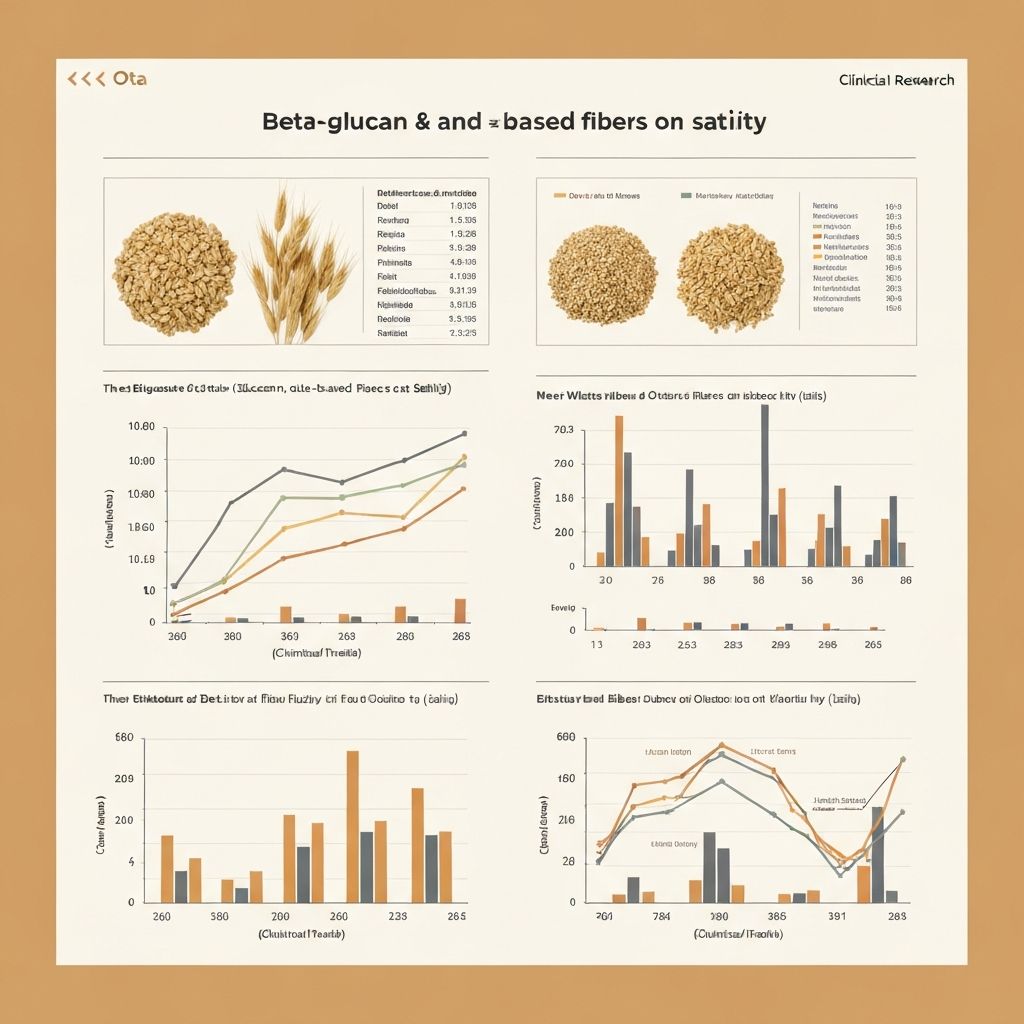
Chemical Structure and Viscosity Profile
Beta-glucan (β-D-glucose polymer) from oats and barley is a linear polysaccharide with mixed 1,3 and 1,4 glycosidic linkages. This structure confers high water-holding capacity and gel-forming properties that exceed those of many other soluble fibres.
Viscosity by Oat Product Type
| Product Type | Beta-Glucan Content | Viscosity (apparent) | Gastric Emptying Effect |
|---|---|---|---|
| Steel-cut oats | 3.5–4.5 g / 100 g | Moderate (particle size limits immediate viscosity) | Modest delay; viscosity develops during mastication and gastric hydration |
| Rolled oats | 3.0–4.0 g / 100 g | Moderate-to-high (flattening increases surface area) | Moderate delay; hydration is rapid |
| Oat flour | 3.5–5.0 g / 100 g | High (fine particles; rapid hydration) | Strong delay; viscosity develops rapidly in stomach |
| Isolated beta-glucan extract | 75–95 g / 100 g | Very high (near-pure solute) | Very strong delay; immediate gel formation |
Clinical Trials on Glycaemic Response
Beta-glucans from oats demonstrate robust effects on postprandial glucose and insulin responses. These metabolic modulations contribute to satiety through multiple pathways:
Acute Trials (Single Meal)
- Glucose peak reduction: Oat beta-glucan (3–5 g) reduces postprandial peak blood glucose by 15–30% compared to equivalent carbohydrate without fibre
- Insulin secretion: Corresponding reduction in insulin area-under-curve (AUC) of 20–40%, reflecting the glucose-sparing effect
- Mechanism: Delayed glucose absorption (viscosity delays small intestinal nutrient delivery) and enhanced GLP-1 secretion from nutrient sensor activation
- Duration: Glycaemic effect persists for 2–3 hours post-ingestion; decays as gastric emptying completes
Second-Meal Effects
Some trials report reduced postprandial glucose responses to a subsequent meal 4–8 hours after consuming beta-glucan-rich oats. This "glycaemic memory" or "second-meal effect" is attributed to colonic fermentation of indigestible beta-glucan fragments and resultant SCFA production, though evidence is inconsistent.
Satiety and Appetite Ratings
Visual analogue scale (VAS) studies consistently demonstrate satiety enhancements with beta-glucan consumption:
Hunger and Fullness Ratings
- Oat beta-glucan (4–5 g) reduces hunger ratings by 15–35% for 2–3 hours post-ingestion
- Fullness (satiation) increases are most pronounced 30–90 minutes post-meal, corresponding to peak gastric distension
- Individual variation is notable: responders show 30–40% hunger reduction; non-responders show minimal change
- Baseline BMI, age, and gender do not consistently predict response magnitude
Ad Libitum Energy Intake Studies
The most functionally relevant marker of satiety is reduction in subsequent spontaneous energy consumption:
| Study Type | Beta-Glucan Dose | Energy Intake Reduction (Next Meal) | Time to Next Meal |
|---|---|---|---|
| Acute (single dose) | 3–5 g | 5–15% reduction | 2–3 hours |
| Acute (higher dose) | 10–15 g | 15–25% reduction | 2–3 hours |
| Chronic (2–4 weeks) | 5–10 g / day | 5–10% reduction (sustained or declining) | Variable; adaptation possible |
Meta-analyses of randomised controlled trials indicate an average 7–12% reduction in next-meal energy intake per 5 g oat beta-glucan consumed. Effect sizes are clinically modest but consistent across diverse populations (healthy adults, individuals with overweight, type 2 diabetes).
Hormonal Responses and Mechanistic Insights
Mechanistic studies using hormone assays illuminate the pathways through which oat beta-glucan promotes satiety:
Cholecystokinin (CCK)
Beta-glucan consumption stimulates sustained CCK secretion through delayed nutrient entry into the small intestine. Peak CCK levels are 25–50% higher than control meals and remain elevated for 2–3 hours, consistent with prolonged appetite suppression.
GLP-1 (Glucagon-Like Peptide-1)
Both immediate GLP-1 secretion (via nutrient sensing and gastroprotein cholecystokinin-releasing peptide mechanisms) and delayed secretion (via colonic fermentation and SCFA) contribute. Peak plasma GLP-1 increases 30–60% above baseline; active GLP-1 (resistant to DPP-4 degradation) remains elevated for 3+ hours.
PYY (Peptide YY)
PYY secretion parallels GLP-1 responses, with peak increases of 20–40% over baseline. The prolonged PYY elevation likely contributes to sustained satiety sensation hours post-meal.
Ghrelin (Appetite Hormone)
Oat beta-glucan suppresses preprandial (fasting) ghrelin levels and blunts the postprandial ghrelin rise, extending the refractory period before appetite returns.
Dose-Response Relationships
Satiety effects of oat beta-glucan exhibit dose-dependency, but the relationship is not strictly linear:
- 3–5 g: Modest satiety effects; approximately 50% of maximal response
- 5–10 g: Dose-dependent increases; approaching plateau at ~80% of maximal response
- 10–15 g: Marginal additional benefit; potential gastrointestinal tolerability issues emerge
- 15+ g: Minimal additional satiety gain; flatulence, bloating, and abdominal discomfort common
The "threshold dose" for clinically meaningful satiety is approximately 5 g per meal. Consuming 3–5 g oat beta-glucan (equivalent to ~50–100 g cooked rolled oats) produces detectable appetite suppression; 10 g (equivalent to ~200 g cooked oats) produces stronger but not proportionally greater effects.
Food Matrix and Preparation Effects
The food matrix (arrangement of fibre, starch, protein, and fat) modulates beta-glucan bioavailability and satiety efficacy:
Whole Grain vs. Isolated Fibre
Whole oat products (oatmeal, steel-cut oats) produce satiety effects comparable to isolated beta-glucan extracts despite lower concentration of fibre, suggesting that structural integrity and associated nutrients (protein, fat, resistant starch) enhance overall satiety response.
Processing Method
Ball-milling and fine grinding increase surface area and accelerate hydration, increasing immediate gastric viscosity. Conversely, coarse steel-cut oats develop viscosity more slowly but sustain effects longer due to prolonged gastric transit.
Liquid vs. Solid Matrices
Beta-glucan in liquid suspension (oat drinks) produces more rapid and pronounced immediate viscosity effects but shorter duration (2–3 hours) compared to whole oat meals. Solid matrices with mixed macronutrients (oats + protein + fat) produce longer-sustained satiety signals via synergistic mechanisms.
Individual Variation and Predictors
Not all individuals respond equally to oat beta-glucan. Predictive factors for stronger satiety responses include:
- Slower baseline gastric emptying rate (responders benefit more from additional delay)
- Higher baseline ghrelin levels (greater room for suppression)
- Lower baseline satiety (perhaps reflecting lower basal L-cell activity)
- Microbiota composition enriched in SCFA-producing species (enhanced fermentation)
- Female sex (some trials report stronger satiety responses in women, though inconsistently)
Pre-trial assessment of baseline satiety hormones and gastric emptying does not reliably predict individual response, suggesting that adaptive factors during the meal influence efficacy more than fixed baseline characteristics.
Long-Term Tolerance and Adaptation
Chronic consumption of oat-based foods containing beta-glucan produces adaptive changes:
- Subjective satiety sensation may attenuate over 2–4 weeks of daily consumption as the gastric mucosa adapts to chronic distension
- Hormonal responses (CCK, GLP-1) often remain elevated even as subjective hunger returns to baseline
- Microbiota may shift towards efficient beta-glucan fermentation, potentially sustaining or enhancing second-meal effects
- Energy intake reduction observed acutely often diminishes during long-term (8+ week) supplementation trials
Key Takeaways
Oat beta-glucan is among the most extensively studied fibres in satiety research. It combines two synergistic mechanisms: immediate viscous gel formation (delaying gastric emptying and nutrient absorption) and fermentability (producing SCFA-mediated GLP-1/PYY secretion 4–8 hours post-ingestion). Clinical trials consistently document 5–15% reductions in subsequent energy intake per 3–5 g beta-glucan, with corresponding modulation of appetite hormones and postprandial glucose responses. Individual responses vary, and chronic adaptation may attenuate acute satiety benefits. The evidence supports beta-glucan as an effective fibre for exploring satiety mechanisms in controlled research settings, though real-world applicability depends on sustained consumption and individual tolerance.